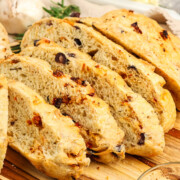
Artesian Italian Bread (with Dipping Oil)
An easy no-knead artisan bread loaded with kalamata olives, sun dried tomatoes, garlic, and oregano. Baked in a dutch oven for a perfect crusty crust, then served with a simple herb dipping oil.
Servings: 10 slices
Calories: 240kcal
Equipment
- Dutch oven (5–7 quart)
- Large mixing bowl
- Wooden or silicone spoon
- Parchment paper
- Wire cooling rack
- Sharp knife (for scoring)
- Measuring cups and spoons
Ingredients
Bread
- 3 ½ cups bread flour
- 1 teaspoon sea salt
- 1 ½ cups warm water 110℉
- 2 ¼ teaspoon fast-acting yeast 1 packet
- 1 teaspoon oregano
- 1 teaspoon crushed or jarred garlic
- ½ cup kalamata olives roughly chopped
- ½ cup sun dried tomatoes roughly chopped (pat dry)
Dipping Oil
- ¼ cup extra virgin olive oil
- 1 teaspoon oregano
- 1 teaspoon crushed or jarred garlic
- 1 teaspoon fresh rosemary fine chopped

Instructions
- In a large bowl, combine flour, sea salt, and yeast. Whisk to distribute evenly.
- Add half the warm water, garlic, olives, and sun dried tomatoes. Stir with a wooden spoon. Add remaining water and mix until all flour is incorporated. Dough will be sticky.
- Cover with plastic wrap and a towel. Place in a warm spot and let rise 2–3 hours until doubled in size.
- Place dutch oven with lid into oven. Preheat to 450°F for 15–20 minutes.
- Turn dough onto a lightly floured piece of parchment paper and gently shape into a round. Lift parchment by all 4 corners and lower into the hot dutch oven.
- Score the top with a sharp knife (2 lines or an X). Add 2–3 ice cubes under the parchment paper for steam.
- Cover and bake 25 minutes.
- Remove lid and bake 10–15 more minutes until deep golden brown (internal temp 200–210°F).
- Lift out using parchment and cool on a wire rack for 15–20 minutes before slicing.
- For the dipping oil: combine olive oil, oregano, garlic, and rosemary in a small bowl. Serve alongside warm bread.
Notes
- Don't skip the ice cubes. The steam they create is what gives dutch oven bread that artisan bakery crust, crackly on the outside and perfectly chewy underneath. This is non-negotiable.
- Use parchment paper, not cooking spray. The parchment makes it easy to lower the dough into the hot dutch oven without burning your hands, and it lifts right out when you're done. Safety first.
- Pat your sun dried tomatoes dry. If they're packed in oil, drain and blot them well with paper towels before adding to the dough. Extra moisture can make the bread gummy in spots.
- Don't rush the rise. The dough needs to fully double in size. In a cool kitchen this can take closer to 3 hours, while a warm kitchen might be done in under 2. Use the proof setting on your oven if you have one.
- Let the bread cool before cutting. Give it 15–20 minutes on the cooling rack. This lets the interior finish baking with residual heat, and you'll get cleaner slices with better texture.
Nutrition
Calories: 240kcal | Carbohydrates: 37g | Protein: 7g | Fat: 8g | Saturated Fat: 1g | Polyunsaturated Fat: 1g | Monounsaturated Fat: 5g | Sodium: 348mg | Potassium: 269mg | Fiber: 3g | Sugar: 2g | Vitamin A: 83IU | Vitamin C: 2mg | Calcium: 26mg | Iron: 1mg
