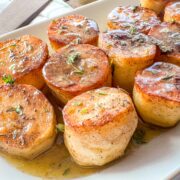
Fondant Potatoes
With their crispy edges, these Fondant Potatoes are a classic French side dish that will elevate the elegance of your next family dinner.
Servings: 4
Calories: 532kcal
Equipment
- 12-inch cast iron skillet
Ingredients
- 2 ½ lbs russet potatoes peeled and cut into 1-inch circles.
- 2 tablespoon avocado oil
- ½ cup salted butter divided
- 1 teaspoon salt
- 1 teaspoon black pepper
- 5 garlic cloves halved
- ½ oz fresh thyme about 10 sprigs
- 1 ½ cups chicken stock

Instructions
- Preheat the oven to 450°F.
- Peel the potatoes and place them in a bowl of salted cold water to prevent them from turning brown while peeling the remainder.
- Pat the potatoes dry with a paper towel.
- Slice the very ends of the potato off to give them flat sides. Then cut the potato into 1-inch discs or cylinders.
- Pat the potato pieces dry with paper towels and season each side with salt and pepper.
- Roughly chop the garlic into halves or quarters, but not too small.
- Add the avocado oil and two tablespoons of butter to a cast iron skillet (or any oven safe skillet) and warm over medium high heat.
- Once hot, place the cut potatoes in the skillet to pan fry. DO NOT TOUCH for 4 minutes, allowing them to get a good sear.
- After the 4 minutes, give the skillet a good shake to prevent the potatoes from sticking. Continue to move the pan (and potatoes) around for another 3-4 minutes. Lower to medium heat if they are browning too quickly, as you do not want them to burn.
- Once the potatoes are golden brown, use a thin spatula like a fish spatula to flip potatoes to the other cut side down.
- Add the remaining butter and once melted, add the garlic cloves and fresh thyme.
- After the thyme and garlic become fragrant (30 seconds to 1 minute), add the chicken stock and give the skillet a good shake to incorporate the butter, herbs, and stock. Bring the stock to a boil.
- Place the cast iron skillet into the preheated oven and bake for 25 minutes or until a small knife blade tip can be easily inserted into the center.
- Discard the garlic and thyme sprigs. Transfer to a serving platter and pour the sauce over the potatoes, or serve directly from the pan.
Optional garnishing
- Sprinkle with a bit of kosher salt, freshly ground black pepper, and a few fresh thyme leaves.
Notes
Cut uniform thickness. Cut potato cylinders to 1 inch thick with flat, parallel surfaces. Uniformity is critical because uneven pieces cook at different rates, leaving you with some overdone and some still raw in the center.
Dry the potatoes before searing. Pat each cylinder completely dry with paper towels. Surface moisture creates steam instead of browning, and you'll end up with a pale, soft surface instead of that golden crust.
Don't move them during the sear. Once the potatoes hit the hot pan, leave them alone for 4-5 minutes per side. Moving them breaks the crust before it forms. You'll know they're ready to flip when they release easily from the pan.
Use a combination of butter and oil. Pure butter burns at the high temperatures needed for searing. Adding avocado or vegetable oil raises the smoke point so you get butter flavor without the black, bitter bits.
The stock should come halfway up the potatoes. Too much liquid and the potatoes boil instead of braise. Too little and the tops dry out. Aim for the stock to reach about halfway up the sides of each cylinder.
Don't skip the oven finish. The stovetop sear creates the crust, but the oven finish is what transforms the interior from raw starch to that creamy, almost custard-like texture. This happens because the starch granules swell and burst as they absorb the hot stock, releasing their contents and creating a smooth, cohesive interior.
Nutrition
Calories: 532kcal | Carbohydrates: 57g | Protein: 9g | Fat: 31g | Saturated Fat: 16g | Polyunsaturated Fat: 2g | Monounsaturated Fat: 11g | Trans Fat: 1g | Cholesterol: 64mg | Sodium: 908mg | Potassium: 1327mg | Fiber: 4g | Sugar: 3g | Vitamin A: 886IU | Vitamin C: 23mg | Calcium: 70mg | Iron: 3mg
